Article 01 · Definitions
What Is Facility Management?
Facility management (FM) is the coordinated discipline of keeping the buildings, systems, grounds and support services of a property running safely, efficiently and cost-effectively. It sits above simple maintenance: where maintenance repairs a broken air-conditioning unit, facility management plans the maintenance schedule, tracks the asset's lifecycle, manages the technicians and vendors involved, and reports on the cost and performance of the whole system.
It also differs from property management, which is mainly concerned with leasing, tenants and rent collection. A facility manager's scope typically spans electromechanical (MEP) systems, cleaning and custodial services, landscaping, pest control, fire and life safety, security support, and manpower supply — everything needed for a building to function as intended, every day, for its full working life.
- Covers both "hard" technical systems and "soft" people-facing services
- Includes planning, budgeting and vendor management — not just repairs
- Measured against agreed service levels rather than one-off jobs
Article 02 · Maintenance Strategy
Preventive vs. Corrective vs. Predictive Maintenance
Corrective maintenance happens after something fails — a pump stops, a light fails, a door closer breaks. It is unavoidable, but relying on it exclusively means downtime, emergency call-out costs and, for critical systems, safety risk.
Preventive maintenance is scheduled work carried out at fixed intervals regardless of the asset's current condition — filter changes, lubrication, calibration — based on the manufacturer's recommended cycle. It reduces failure rates dramatically but can mean servicing equipment that didn't yet need it.
Predictive maintenance uses condition data — vibration, temperature, run-hours, visual inspection findings — to service equipment just before it is likely to fail, rather than on a fixed calendar. It is the most efficient approach but requires monitoring and a maintenance history to work from. Most well-run facility contracts blend all three: preventive schedules for routine assets, predictive checks for critical plant, and a fast corrective response for the rest.
Article 03 · Systems & Tools
CMMS: Computerised Maintenance Management Systems
A CMMS is software that logs every asset in a facility — pumps, chillers, fire panels, generators — along with its maintenance history, warranty status and spare-parts inventory. When a fault is reported, it is opened as a work order, assigned to a technician, tracked to completion and archived, so nothing is handled by memory or a paper logbook.
For the client, a CMMS turns maintenance into something that can be audited: response times, recurring faults, parts consumption and technician workload are all reportable. For the contractor, it is what allows preventive schedules to actually run on time across dozens or hundreds of assets at once, instead of drifting as staff change.
Article 04 · Contracts
SLAs and KPIs in Facility Contracts
A Service Level Agreement (SLA) is the section of a contract that defines exactly what "good service" means in measurable terms — for example, that an emergency electrical fault must receive an on-site response within two hours, or that common areas must be cleaned to a defined standard twice daily.
A Key Performance Indicator (KPI) is the metric used to check whether the SLA was actually met — response time in minutes, first-time-fix rate, number of repeat complaints, cleanliness audit score. Without KPIs, an SLA is just a promise; without an SLA, a KPI has nothing to be measured against. Together they let a client hold a facility contractor accountable without having to inspect every task personally.
Article 05 · Building Systems
MEP Systems Explained
Mechanical, Electrical and Plumbing — together, MEP — are the three engineered systems that make a building usable: HVAC and ventilation (mechanical), power distribution, lighting and low-current systems (electrical), and water supply, drainage and fire-fighting water systems (plumbing). Electromechanical maintenance, one of the most common services requested from facility contractors, covers exactly this overlap between electrical and mechanical trades.
MEP systems are usually the most safety-critical and highest-value assets in a facility, and the leading cause of both energy cost and unplanned downtime when neglected — which is why they typically receive the most structured preventive maintenance schedule of any category.
Article 06 · Pest Control
Integrated Pest Management (IPM)
Integrated Pest Management is a structured, evidence-based approach to pest control that starts with inspection and prevention — sealing entry points, removing food and water sources, monitoring with traps and bait stations — and treats chemical application as one tool among several, used only where and when it is actually needed.
This differs from a purely reactive approach of spraying on a fixed schedule regardless of pest activity, which is both less effective over time and less appropriate for food-handling, healthcare or hospitality environments where chemical exposure must be minimised.
Article 07 · Service Categories
Hard FM vs. Soft FM Services
Hard FM refers to technical, often life-safety-critical services tied to the building's physical fabric and systems: electromechanical maintenance, fire and life safety, plumbing, HVAC, structural repairs. These require licensed technicians and are usually governed by strict codes and inspection cycles.
Soft FM covers the services that support the people using the building rather than its systems: cleaning, landscaping, pest control, manpower supply, reception and hospitality staffing. Both categories are essential, and most established facility contractors — including single-source providers — offer both, since a client managing separate vendors for each often loses the accountability that a unified SLA provides.
Article 08 · Safety & Compliance
Fire & Life Safety Systems
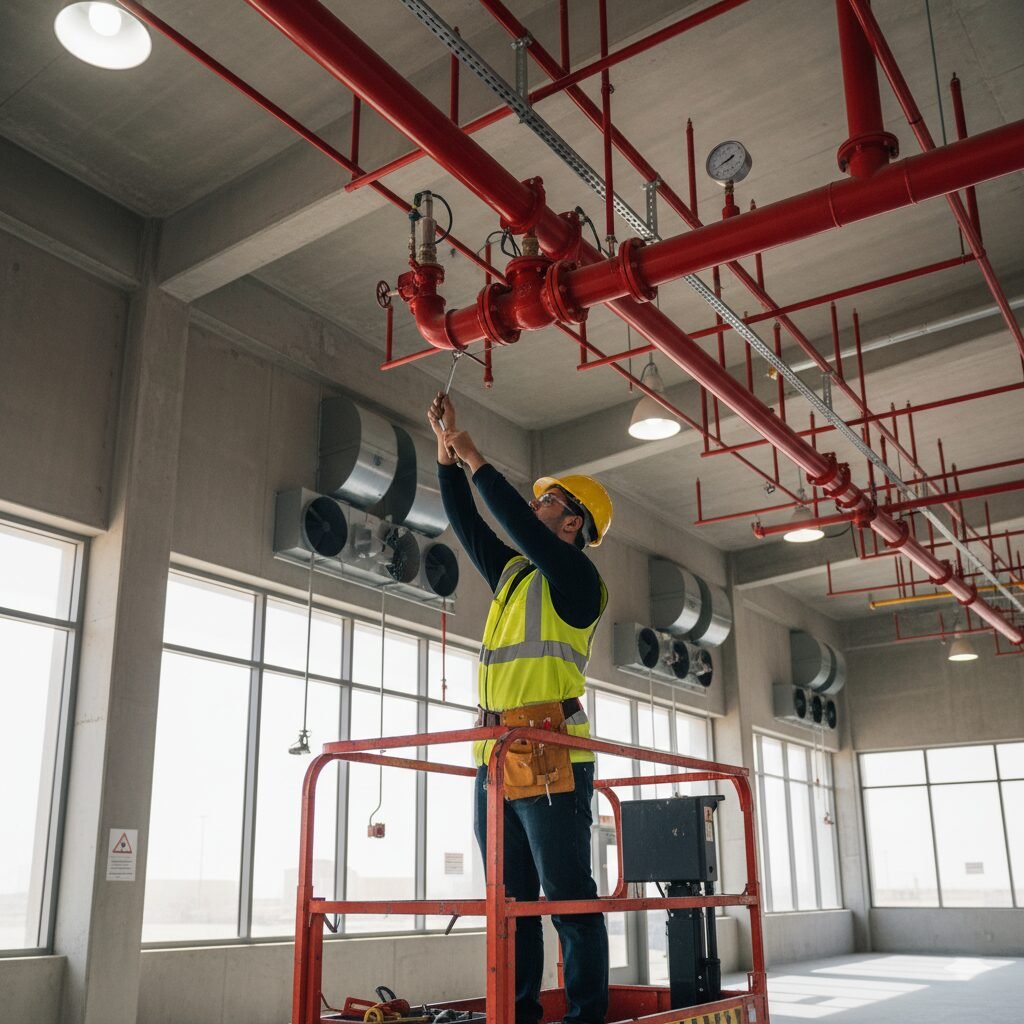
Commercial buildings in Saudi Arabia are required, under Civil Defense regulations, to maintain functioning fire detection (smoke and heat detectors, alarm panels), suppression (sprinklers, fire extinguishers, hose reels) and evacuation systems (emergency lighting, signage, clear exit routes). These are not one-time installations — every component has a required inspection and testing interval, and a lapsed certificate can affect a building's operating license.
Facility contractors typically manage the testing calendar, coordinate with certified inspection bodies, and maintain the documentation trail that proves compliance during an audit or after an incident.
Article 09 · Sustainability
Sustainability & Energy Efficiency in Facility Operations
Much of the energy waste in a typical building has nothing to do with the building's design and everything to do with how its systems are operated day to day — HVAC running outside occupied hours, lighting left on in empty areas, poorly maintained equipment drawing more power than it should. Facility management addresses this operationally, without requiring a capital retrofit: adjusting schedules, fixing small faults before they become large ones, and tracking utility consumption over time to catch anomalies.
Water-efficient irrigation scheduling in landscaping and responsible water use in cleaning operations fall under the same principle — sustainable outcomes achieved through disciplined day-to-day operation rather than a single upgrade project.